
What Does the “G” Mean on a Manual Stick Shift? Many Drivers Don’t Know
If you have ever driven a manual-transmission vehicle, you may have noticed an unfamiliar “G” marked on the gear selector or gear diagram.
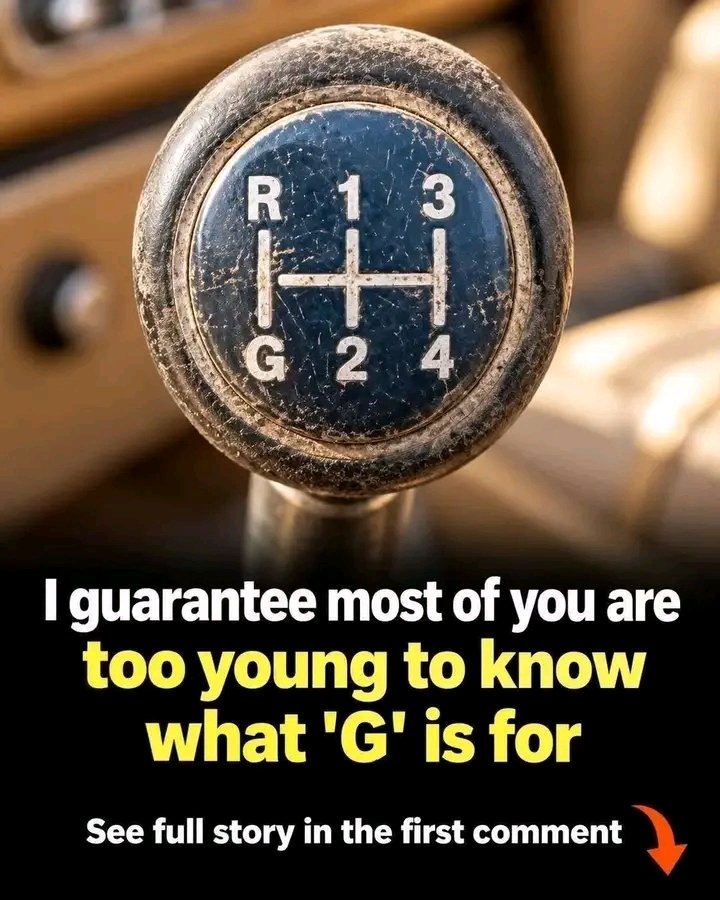
For many drivers, the letter raises an obvious question: What does G actually mean?
The answer is surprisingly interesting because, unlike the familiar numbers 1 through 5 or 6, the letter “G” can have a specialized meaning depending on the vehicle.
What Does “G” Stand For?
In many vehicles, particularly some European models and certain off-road or commercial vehicles, “G” refers to a special low-range or reduction gear.
The letter is commonly associated with the German word “Gelände,” meaning “terrain” or “off-road.”
A G gear is designed to provide very high pulling power at low speeds. Instead of being intended for normal road driving, it can help a vehicle move slowly over difficult surfaces or when carrying heavy loads.
However, the exact meaning of “G” is not universal. The meaning depends on the vehicle’s manufacturer and transmission design.
Why Would a Vehicle Need a G Gear?
Normal first gear is already designed to provide strong pulling power.
But some vehicles need even more torque at very low speeds.
A low-range or crawler-type gear can be useful when:
- Driving over steep terrain
- Moving through mud or sand
- Climbing rocky surfaces
- Pulling heavy loads
- Starting with a heavy trailer
- Maneuvering slowly off-road
- Driving on particularly steep descents
The purpose is not to make the vehicle faster.
It is almost the opposite.
The vehicle moves more slowly while the engine can continue producing useful torque.
How Is G Different From First Gear?
Imagine you are trying to push a heavy object.
You could push it quickly, but it would require considerable force. If you use a mechanical advantage that allows you to move it slowly, you can apply much greater force.
A low gear works on a similar principle.
First gear provides a high amount of torque multiplication, but a special crawler or reduction gear can provide even greater mechanical advantage.
The trade-off is that the vehicle’s speed becomes extremely low.
When Should You Use G?
If your vehicle is equipped with a genuine G or crawler gear, it should generally be used only in situations where its additional torque and very low speed are useful.
For example, an off-road driver may select it when climbing a very steep obstacle or moving slowly through difficult terrain.
Using a low-range gear unnecessarily on ordinary pavement can be inappropriate because the vehicle is designed to operate at extremely low speeds in that mode.
Always follow the vehicle manufacturer’s instructions because the correct procedure varies between transmissions.
Is G the Same as Reverse?
No.
Reverse is normally marked with R.
A G gear is generally intended to provide very low-speed forward movement and increased pulling power.
However, gear layouts differ considerably between vehicles, so drivers should check the transmission diagram or owner’s manual before attempting to use an unfamiliar gear.
Why Don’t Most Cars Have a G Gear?
Most modern passenger cars are designed primarily for normal road use.
Their first gear is usually sufficient for:
- Starting from a stop
- Driving in traffic
- Climbing ordinary hills
- Normal acceleration
A dedicated crawler gear adds mechanical complexity and is mainly useful for vehicles designed to carry heavy loads or operate in demanding conditions.
That is why you are much more likely to encounter such a gear in an off-road vehicle, truck, agricultural machine, or specialized commercial vehicle than in an ordinary family car.
Don’t Assume Every “G” Means the Same Thing
One important detail is that “G” is not a universal transmission symbol.
Manufacturers can use letters differently, and some gear selectors may use G to identify a particular transmission mode rather than a traditional crawler gear.
If you see a G on your own vehicle, the safest approach is to check the owner’s manual.
The gear diagram will tell you exactly what the manufacturer intended and when it should be used.
Final Thoughts
The mysterious “G” on a manual gear selector is often associated with a low-speed, high-torque gear designed for difficult terrain or heavy-duty work.
The idea behind it is simple: sacrifice speed to gain mechanical advantage.
So the next time you see a G on a gear pattern, don’t assume it is simply another ordinary gear.
It may be there for one very specific purpose: helping the vehicle crawl when normal gearing isn’t enough.
Always consult your vehicle’s owner’s manual before using an unfamiliar gear or transmission mode. Gear markings and operating procedures vary between manufacturers and models.